Personas
Charles, Ozzy, and Personas' Importance
Publishing Team August 30, 2025 6 min read
blog image
Charles, Ozzy, and Personas' Importance
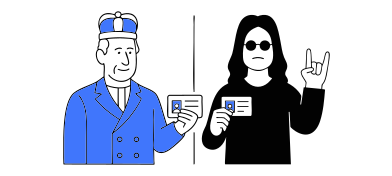
King Charles and Ozzy Osbourne might not be the duo you’d expect side by side, yet their similarities are striking:
  • Both born in 1948
  • Raised in England
  • Married twice
  • Have children
  • Wealthy
  • Live in castles
On paper, they fall neatly into the same segment.But their personas couldn’t be more different:
  • Charles is a monarch devoted to tradition and duty
  • Ozzy is the “Prince of Darkness,” known for rock music, rebellion, and eccentricity
Now imagine they both need to renew a driver’s license:
  • Charles may expect dignity, formality, and efficiency
  • Ozzy might want speed, simplicity, and flexibility
Same segment. Same service. Completely different personas
That is why personas matter. They go beyond age, income, and address. They capture motivations, fears, frustrations, and goals. In public services, this distinction is everything. A retiree may fear digital forms, while a graduate just wants speed.
Segments tell you who citizens are. Personas reveal why they act the way they do.
Why Designing for the “Average Citizen” Always Fails
  • On spreadsheets, citizens are grouped by demographics
  • In reality, services are experienced emotionally, subjectively, and contextually.
  • Governments often design for an “average citizen” who does not exist.
The result: citizens leave interactions thinking services were not designed for people like them.
The Real Challenges: Why It Matters
  • 1. Citizens do not compare governments to governments anymore.
    They compare services to their best digital experiences such as booking flights, ordering groceries, or streaming shows. Without accurate persona journeys, public services risk falling behind in trust and relevance.
  • 2. Not one size fits all
    Government services are rarely one-size-fits-all. For example, business licensing might involve:
    • Two segments: nationals and expats
    • Two personas for each: newcomer and existing investor
    • Two delivery channels: online and in-person
    This already creates eight unique experiences.
  • 3. Speed and cost matter.
    Public sector teams often face limited staff and tight deadlines. Properly mapping customer journeys can take hours of workshops and extensive effort.
  • 4. The trust gap.
    The gap between what governments design and what citizens experience is often large.
A 2024 OECD survey found that only 47% of citizens in OECD countries trust their government to deliver services effectively (OECD, 2024).
Much of this mistrust comes from inconsistent or frustrating service experiences.
Our Solution: Closing the Gap Between Design and Real Citizen Experience
With xqual, governments no longer design for an abstract citizen.
AI-powered Journey Mapping instantly generates multiple journeys, each tailored to different personas and segments.
How it works:
  • Input service data such as customer segments, service personas, and delivery channels
  • The system multiplies these variables and outputs clear, separate maps
  • Teams can then analyze friction points, test improvements, and redesign the service experience
The result: citizens leave interactions thinking services were not designed for people like them.
Four Core Benefits of xqual Journey Mapping
  • 1. Bridging the trust gap
    When services are designed for people like them, citizens feel recognized and trust grows.
  • 2. Every citizen seen
    From retirees wary of digital forms to graduates expecting instant results, every persona is included in the design process.
  • 3. Automate what needs to be automated
    Hours of sticky-note workshops are replaced by seconds of AI-driven insights. Teams can focus on real improvements
  • 4. Saving hundreds of hours
    With staff shortages and tight deadlines, xqual reduces manual effort and frees up valuable time for problem-solving, innovation, and better service delivery.
Beyond Mapping: Future-Ready Capabilities
The journey mapping module is not static. It evolves with citizens and adds new capabilities:
  • Real-time analytics: live citizen feedback updates maps instantly, showing where frustrations spike and satisfaction drops
  • Cross-agency journeys: connect services seamlessly, for example starting a business that spans licensing, taxation, and social security
  • Scenario testing: run simulations to test improvements before implementation
  • Workflow conversion: turn journey maps directly into workflows, closing the gap between design and execution
Ready to See It in Action?
Governments worldwide are rethinking how they design experiences. The leaders are not waiting.
Join our waiting list for a demo today and meet an associate who will walk you through how xqual can transform citizen journeys.
References
  • OECD (2024). Trust in Government – Citizens’ Perspectives. OECD Data and Reports.
  • World Bank (2023). Citizen-Centric Digital Transformation in Public Services. World Bank Digital Development Reports